
Department of International Relations
Department of International Relations
Department of International Relations
Department of International Relations

News
23.02.2026 10:15
Global Finance and Economics Media Giant Nikkei Focuses on Turkish Higher Education in New Analysis
February 23, 2026
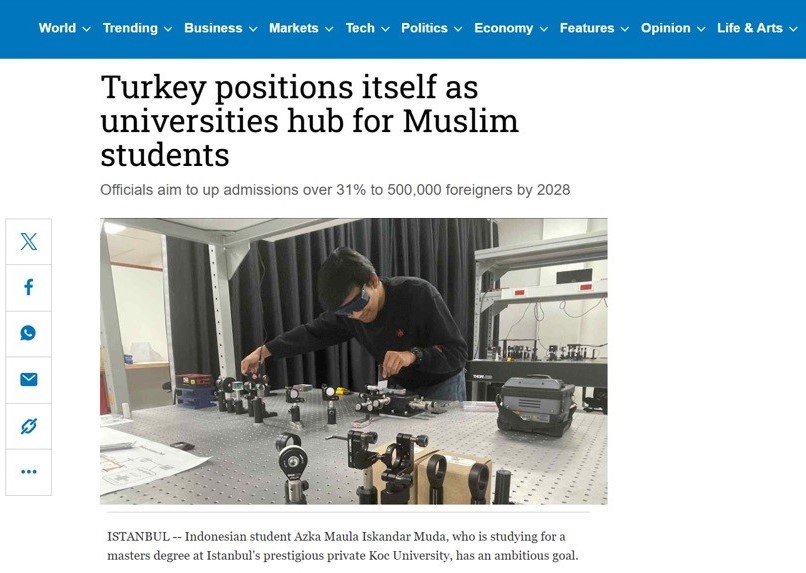
Nikkei, the Japan-based global financial and economic media organization, has placed Turkish higher education at the center of its latest analysis.
In the article published by Nikkei Asia, Türkiye was described as becoming a strong higher education hub, particularly for students from Muslim-majority countries, highlighting the significant rise in the number of international students over the past decade.
The comprehensive report—prepared after visiting universities in Türkiye, conducting interviews with international students, and receiving comments from President of the Council of Higher Education Erol Özvar—demonstrates the global recognition and success of Türkiye’s internationalization strategy in higher education in recent years.
The article noted that approximately 80 percent of international students in Türkiye come from Muslim-majority countries, with 65 percent originating from Asia, including the Middle East, and 14 percent from Africa.
The analysis also featured the views of President of the Council of Higher Education Erol Özvar and international students studying in Türkiye.
In his interview with the newspaper, Özvar stated that Türkiye competes intensely with Malaysia, China, the United States, the United Kingdom, and Australia in attracting Asian students. Emphasizing that shared faith, historical ties, and cultural proximity form the foundation of these figures, Özvar added that high educational quality, geographical proximity, and affordability encourage students to choose Türkiye.
Özvar also noted that Türkiye aims to diversify student recruitment by attracting more students from South Asia, the Association of Southeast Asian Nations (ASEAN), and East Asia, recalling that Türkiye has signed higher education cooperation agreements with Indonesia, Afghanistan, Bangladesh, Pakistan, Brunei, Malaysia, the Philippines, Thailand, and Vietnam.
Highlighting that Türkiye is part of the European Higher Education Area, Özvar said, “We expect students who may be affected by Trump’s migration and visa policies to turn their attention to Türkiye as a safe and high-quality alternative.”
He added that Turkish universities would increase participation in international education fairs and strengthen social media and other digital communication channels to attract more international students.
Özvar also stated that the Council of Higher Education is in discussions with universities to encourage wider use of TR-YÖS, Türkiye’s own international student admission exam, to improve student quality. He emphasized, however, that many institutions already evaluate applicants using internationally recognized criteria such as the International Baccalaureate, Abitur (German qualification certificate), and SAT (U.S. university entrance exams).
- Indonesian student Muda: “METU’s facilities and opportunities are superior”
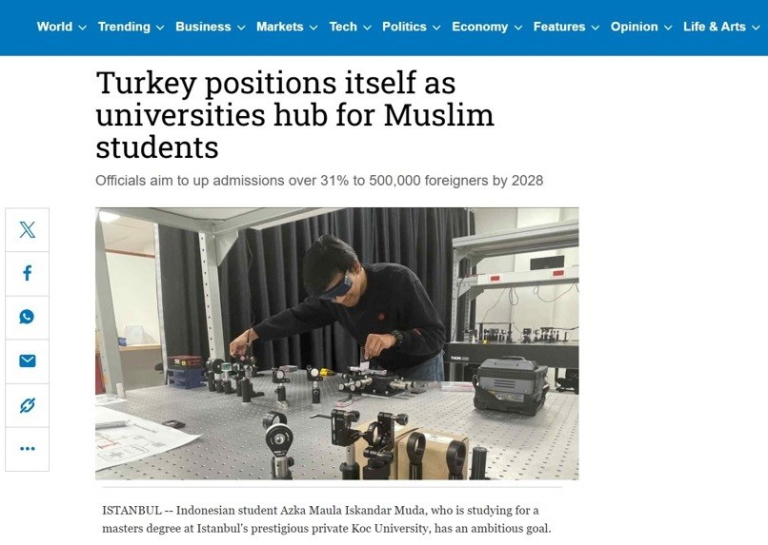
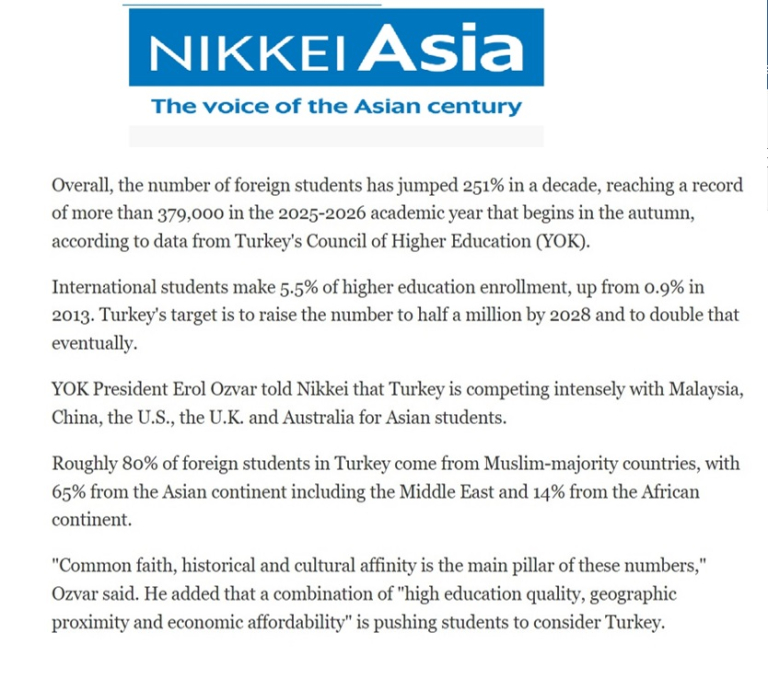
The Nikkei report also included an interview with Indonesian student Azka Maula Iskandar Muda, who is pursuing a master’s degree at Koç University. Stating that he aims to change the future of computer science and hopes to work at companies such as Nvidia, Intel, and Microsoft, Muda explained that he chose to pursue his undergraduate degree in physics at Middle East Technical University (METU), one of Ankara’s leading public universities, instead of studying at a European institution. “Despite similar tuition levels, METU’s facilities, resources, and research opportunities were superior,” he said.
Muda is one of more than 5,460 Indonesian university students currently studying in Türkiye. This figure has increased by approximately 655 percent over the past decade, making Indonesia the 16th largest source of international students. During the same period, the number of Pakistani students nearly quadrupled, exceeding 6,075.
The report stated: “According to data from the Turkish Council of Higher Education, the total number of international students increased by 251 percent over the past decade, surpassing 379,000 in the 2025–2026 academic year and reaching a record level.
International students now account for 5.5 percent of higher education enrollments, compared with 0.9 percent in 2013. Türkiye aims to raise this number to half a million by 2028 and then double it thereafter.
For Muda, the combination of quality education and affordable costs made Türkiye especially appealing. A research article he published at METU caught the attention of Koç University, earning him a full graduate scholarship covering tuition, accommodation, and a monthly stipend. Working on photonic neural networks, Muda said, ‘I design optical chips, and in most parts of the world you design them in one place and manufacture them elsewhere. Here, I can simply go downstairs and produce them using a lithography machine for 150 lira per hour.’ The production process cost him only 2,000 liras, whereas in Europe it could cost thousands of euros.”
- “Most international students come from Turkmenistan”
The article also highlighted that four Turkish universities ranked among the top 500 in the Times Higher Education World University Rankings 2026, while a total of 15 Turkish universities entered the top 1,000.
According to the analysis, Turkmenistan ranks first among countries sending students to Türkiye, with 65,884 students accounting for more than 17 percent of the total 379,507 international students. Turkmenistan is followed by Syria, Azerbaijan, Iran, Uzbekistan, and Kazakhstan.
The article further stated: “Turkish universities and civil society organizations have also opened academic units in Azerbaijan, Uzbekistan, and Kazakhstan. Erol Özvar noted that similar plans exist for Iraq and Pakistan. In October, Turkish President Recep Tayyip Erdoğan stated that 95 percent of international students cover their own tuition, accommodation, and other expenses, contributing approximately $3 billion annually to the economy.”
- “They aim to increase English-medium education”
The Nikkei report noted that approximately 75 percent of international students study in Turkish, while 23 percent study in English, and that authorities aim to increase the share of English-medium instruction.
The article added: “Turkish and other Turkic languages and dialects are spoken across the South Caucasus, Central Asia, the Balkans, and the Middle East. The global popularity of Turkish television series has also contributed to attracting students who are somewhat familiar with Turkish. Alongside strong interest from Central Asia, the country attracts significant numbers of students from the Middle East, particularly neighboring Syria, as well as Iran, Iraq, Egypt, and other countries.”
- Iranian student Kazeminezhad: “Türkiye feels like home to me”
The report also featured an interview with 21-year-old Pakistani student Muhammed Bilal Hassan, who studies civil engineering at Yıldız Technical University. Hassan noted that the biggest challenge for him was the language barrier, saying, “Although my courses are in English, some instructors switch to Turkish during lectures. Knowing Turkish is necessary.”
The article concluded with information about Samar Kazeminezhad, a third-year Iranian business administration student at the same university: “Kazeminezhad is a member of Iran’s large Azerbaijani Turk community, many of whom watch Turkish television series and have relatives in Türkiye. Studying to become a certified financial analyst, she pays an annual tuition fee of 50,000 lira and spends about $250–300 per month excluding accommodation. ‘Türkiye feels like a homeland to me,’ she says.”
The full article can be accessed at the following link:
https://asia.nikkei.com/business/education/turkey-positions-itself-as-universities-hub-for-muslim-students
Other News
High-Achieving Students Choose ...
24.09.2026
University Bridge Between Türkiye and ...
22.09.2026
Türkiye Launches New Project for ...
17.09.2026
Turkish Higher Education Launches ...
15.09.2026
From Brotherhood to Concrete Academic ...
14.09.2026
CoHE President Özvar to Visit Pakistan ...
12.09.2026
Turkish Students in Iran Given ...
12.09.2026
World Champion Choir Visits CoHE
08.09.2026